The Number Everyone Asks For (and the Five They Should)
Insights · November 2026
“What are your returns?” It is often the first question a prospective client asks, and it is a reasonable one. Performance matters, and any firm managing significant wealth should be prepared to discuss it. But on its own, a single return figure reveals surprisingly little about whether a portfolio is serving the family behind it.
The founders, financial professionals and multi-generational families we serve deserve a fuller answer. Here is how we think about performance: start with the number, then ask five more questions.
First, the number
Here’s the honest answer: there is no single Omnia return, and there shouldn’t be. A fund has one portfolio and one track record. A multi-family office builds a separate portfolio for every family, shaped around its own goals, challenges, taxes and timeline. A family preserving wealth for its grandchildren and a young tech entrepreneur preparing for a liquidity event shouldn’t own the same things, so they won’t earn the same returns. Asking a family office for its firm-wide return is, in effect, treating it like a fund.
That doesn’t mean the numbers are hidden. We track and audit every investment we make on behalf of our families, and we’re glad to walk through our historical track record. When the conversation turns to returns, we steer it toward the measures that actually matter: returns after all fees, over three, five and ten years, measured against benchmarks that match each portfolio’s risk, with an after-tax view for taxable families. That’s where a better conversation begins.
The same discipline applies to how we invest. We review every investment before we make it and again after: what worked, what didn’t, what we did well and where we fell short. Our dedicated funds, built to give clients access to institutional strategies through partnerships with top-tier managers, are audited and administered by independent third-party firms.
We believe strong risk management is one of the main keys to performance over time. That’s why constantly questioning ourselves is part of our process.
Why the number feels so loud right now
For most of the 2010s, money was close to free. When rates sit near zero, almost everything rises together, and plenty of advisors looked brilliant. The tide did most of the work.
That era is over. Cash and bonds pay something again, and the gap between winners and losers has widened. Skill, or its absence, is easier to see.
There’s a second wrinkle. The S&P 500 sounds like a bet on 500 companies. In practice, the ten largest now make up close to 40% of the index, up from about 18% in 2015, based on J.P. Morgan data. Most are tied to the same AI spending cycle.
~18% top-ten share of the S&P 500 in 2015 → ~40% today
We’ve seen this before. In the early 1970s, the “Nifty Fifty” growth stocks were considered safe at any price, until the 1973–74 bear market left many of them years from recovery.
So, when a manager says they kept pace with the market, ask them what that means. Often, it means owning the same few stocks as everyone else: a concentrated bet few families would make on purpose.
1. Compared to what?
A return means nothing until you know what it’s measured against, over what period, and with how much risk. Ten percent is a terrific year for a conservative portfolio built to cover living expenses, and a disappointing one for an aggressive equity-heavy account in a strong market.
Two portfolios can post the same return while one gives you a smooth ride and the other has you checking your phone at 2 a.m. That isn’t the same result.
At Omnia, the benchmarks we use are discussed and visible on every client report. Success is defined before the first dollar goes in, not after the year ends and someone goes looking for a flattering comparison.
2. What did I actually keep?
The return people mention – and often brag about – at dinner parties is usually pre-tax. The one that pays for things is after tax and after fees. For families blessed with wealth, taxes often cost more than fees, yet they get far less attention. Morningstar data cited by Dimensional show that in the year ending September 2025, the average tax cost of funds was higher than their average expense ratio across fund categories.
A simple hypothetical shows why. Two families each invest $20 million and earn 8% a year before taxes. The first family’s portfolio loses two points a year to taxes. The second, through tax-loss harvesting, careful asset location and sensible timing of gains, loses one. After 20 years, the first family has about $64 million. The second has about $77 million. Same markets, same headline return, roughly $13 million apart. That’s compounding at work. Every dollar lost to taxes is a dollar that never earns another dollar, and the cost grows every year it stays gone.
Families sometimes ask whether they should give up some return to get tax and estate planning. We think that’s the wrong frame. The question isn’t whether you’d trade return for service. It’s whether you’re counting all of the return. Because our investment, tax and estate professionals sit at the same table, tax efficiency is built into how the portfolio is run, not tacked on in April.
3. What happened in your worst year?
Averages can often hide the moments that matter. A portfolio that falls 50% needs to gain 100% just to get back to even. Compounding is the most powerful force in building wealth, but only if it isn’t interrupted. A deep loss doesn’t just cost money; it costs the years of growth that money would have produced.
2022 made the point painfully. The S&P 500 fell 18.1% and U.S. bonds lost 13%. Bonds are supposed to cushion stock losses; that year they fell right alongside them. Plenty of portfolios that looked diversified on paper turned out to be one bet wearing two labels.
“That year reinforced how we build. We diversify across sources of return that behave differently under stress, and we size every position so no single bet can sink a family’s plan.”
Alon Ozer, Partner and Chief Investment Officer
As investors who come from the institutional world, we’ve seen that the path to top performance over time runs through risk management, not through chasing the highest return in any given year. Consistently high returns aren’t possible without taking on higher risk, and in years like 2022 much of those gains can be given back, and quickly. Avoiding large drawdowns is hard, but it makes a big difference to long-term results, because capital that isn’t lost keeps compounding. It also leaves room to act: in both 2020 and 2022, we were able to deploy capital into new opportunities that contributed significantly to our clients’ long-term returns.
So, ask any advisor about their worst year and what they did. At Omnia, resilience also means seeing risks before they reach prices. Conflicts, sanctions, and energy shocks tend to be treated as noise by standard portfolio models until the damage is done. Omnia’s investment team weighs them in advance, because markets rarely price a crisis until it arrives. Our recent webinar on energy security and AI infrastructure explored exactly these risks. The goal is simple: real diversification, not thirty funds that all own the same stocks.
4. Where are the returns coming from?
Some returns come from simply being in the market. Some come from taking more risk or using leverage. Some come from luck. And some come from genuine skill. Only the last is worth paying for.
Given how top-heavy public markets have become, it’s worth asking whether a portfolio has returns that don’t depend on the same few companies. For many of the families we serve, that means private markets: low beta, non-correlated funds, private credit that earns income from loans rather than stock prices, real assets, private equity, and early-stage technology most investors never see. None of it belongs in a portfolio just because it’s exclusive. Each opportunity must clear our due diligence, and families need to accept the trade-off that some of this money may be tied up for some time.
The conventional view of diversification is that spreading money across uncorrelated assets protects a portfolio when any one of them performs badly. The principle is sound, but in practice it’s not that simple. Many investors believe they’re diversified because their assets haven’t moved together in the past, only to discover at the worst possible moment that they all fall at once. Assets that look unrelated often share the same underlying risk factors, and the relationships between them shift over time and across different economic environments. At Omnia, we build portfolios by looking past historical correlations to the risks each investment actually carries, so that our families are diversified when it matters most, not just on paper.
5. Returns toward what?
In the end, the right benchmark isn’t the S&P 500. It’s your family’s life.
Consider a founder who has just sold her company. Her questions aren’t about the index. How much can she spend without running out? How should the proceeds be structured before her children inherit? How much can go to the causes she cares about, and in what form? Will she have cash ready if another venture comes along?
Answering those takes investment, tax and estate expertise, plus someone who can help a family talk about money across generations. At Omnia, those people work on her plan together from the first meeting, and we measure performance against the goals she set.
“The returns question usually opens the meeting. The real conversation starts later, when a family talks about their children, their business, or what they want their wealth to make possible.”
Lawrence Muscant, Partner and Executive Vice President
A portfolio that beats the index but misses the plan has failed. One that trails a hot market but meets every goal has done its job. This is the conversation we believe every first meeting should start with.
Back to the table
So yes, when a prospective client asks about our returns, we’ll share the historical track records of our investments. Then we’ll encourage them to ask us, and every other advisor, five more questions.
Five questions to ask any advisor
- Compared to what benchmark, and who chose it?
- What were the returns after fees and taxes?
- What was your worst year, and what did you do?
- Where are the returns coming from?
- How will you measure success against my family’s goals?
Wealth is built by compounding over decades, not by winning any single year. The number everyone asks for tells you where a portfolio has been. The other five tell you whether it will get your family where it’s going.
Sources
- S&P 500 concentration: J.P. Morgan data, as reported by Landmark Wealth Management (July 2026).
- 2022 equity and bond market returns: Dimensional Fund Advisors, “Market Review 2022.”
- Tax costs relative to fund expense ratios: Dimensional Fund Advisors, “The Hidden Cost of Taxes” (November 2025), citing Morningstar.
Hypothetical illustration disclosure
The $20 million compounding example is hypothetical and for illustrative purposes only. It assumes a constant 8% annual pre-tax return and annual tax costs of 2% versus 1%, resulting in illustrative 6% and 7% after-tax growth rates over 20 years. This is not meant to represent actual Omnia client performance, does not account for investment advisory fees or other expenses, and does not guarantee future results. Actual outcomes will vary based on market conditions, taxes, fees, timing, and individual circumstances. Tax-loss harvesting and other tax strategies may not be suitable or effective for every investor.
Important information
Omnia Family Wealth, LLC (“Omnia Family Wealth”) is a registered investment advisor with the SEC. Advisory services are only offered to clients or prospective clients where Omnia Family Wealth and its representatives are properly licensed or exempt from licensure.
The information provided is for educational and informational purposes only and does not constitute investment advice and it should not be relied on as such. It should not be considered a solicitation to buy or an offer to sell a security. It does not take into account any investor’s particular investment objectives, strategies, tax status or investment horizon. You should consult your attorney or tax advisor.
The views expressed in this commentary are subject to change based on market and other conditions. These documents may contain certain statements that may be deemed forward looking statements. Please note that any such statements are not guarantees of any future performance and actual results or developments may differ materially from those projected. Any projections, market outlooks, or estimates are based upon certain assumptions and should not be construed as indicative of actual events that will occur.
All information has been obtained from sources believed to be reliable, but its accuracy is not guaranteed. There is no representation or warranty as to the current accuracy, reliability or completeness of, nor liability for, decisions based on such information and it should not be relied on as such.
For additional information, please visit our website at www.omniawealth.com. For current Omnia Family Wealth information, please visit the Investment Adviser Public Disclosure website at www.adviserinfo.sec.gov by searching with Omnia Family Wealth’s CRD #170909.
Have Questions for An Advisor?
RELATED ARTICLES
Who Keeps the Lights On?
Read More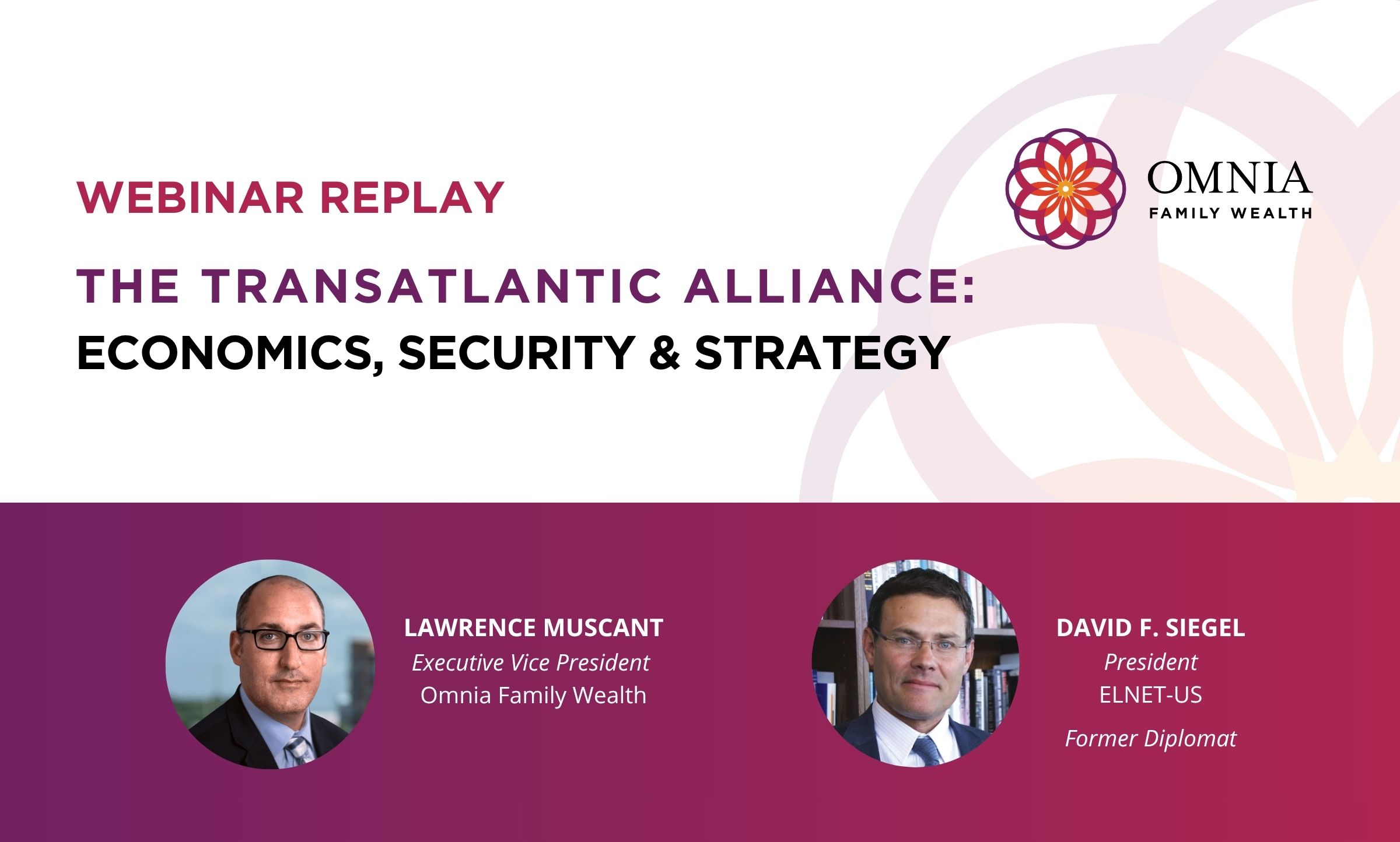
Webinar Replay: The Transatlantic Alliance: Economics, Security & Strategy
Read More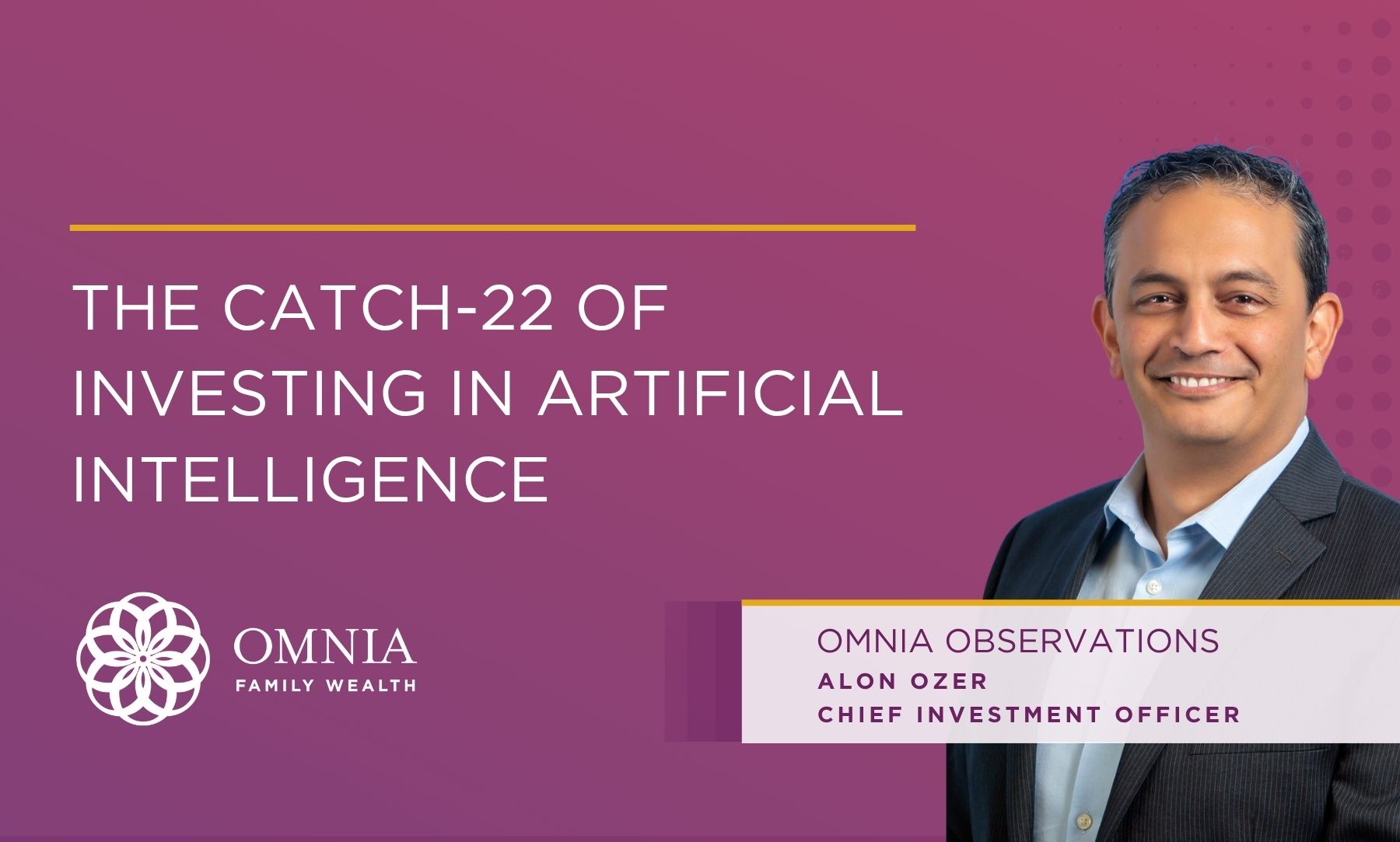
THE CATCH-22 OF INVESTING IN ARTIFICIAL INTELLIGENCE
Read More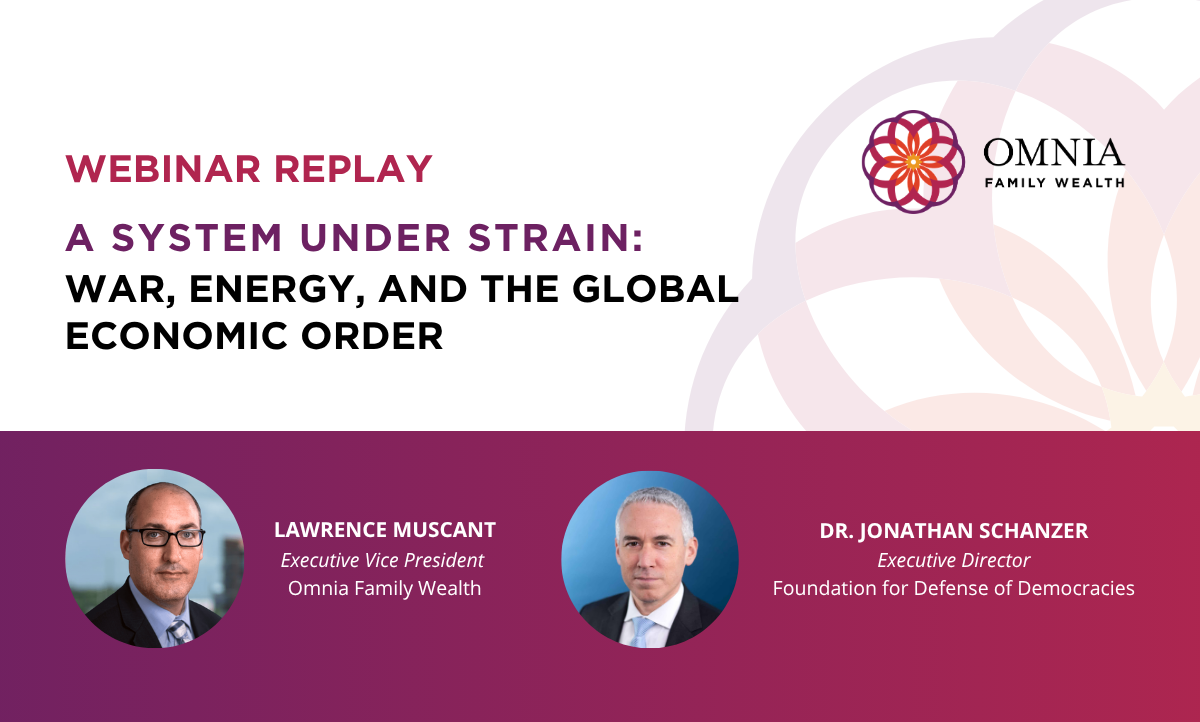
Webinar Replay: A System Under Strain — War, Energy, and the Global Economic Order
Read More
PRIVATE CREDIT: DATA, DISCIPLINE, AND DIVERSIFICATION
Read More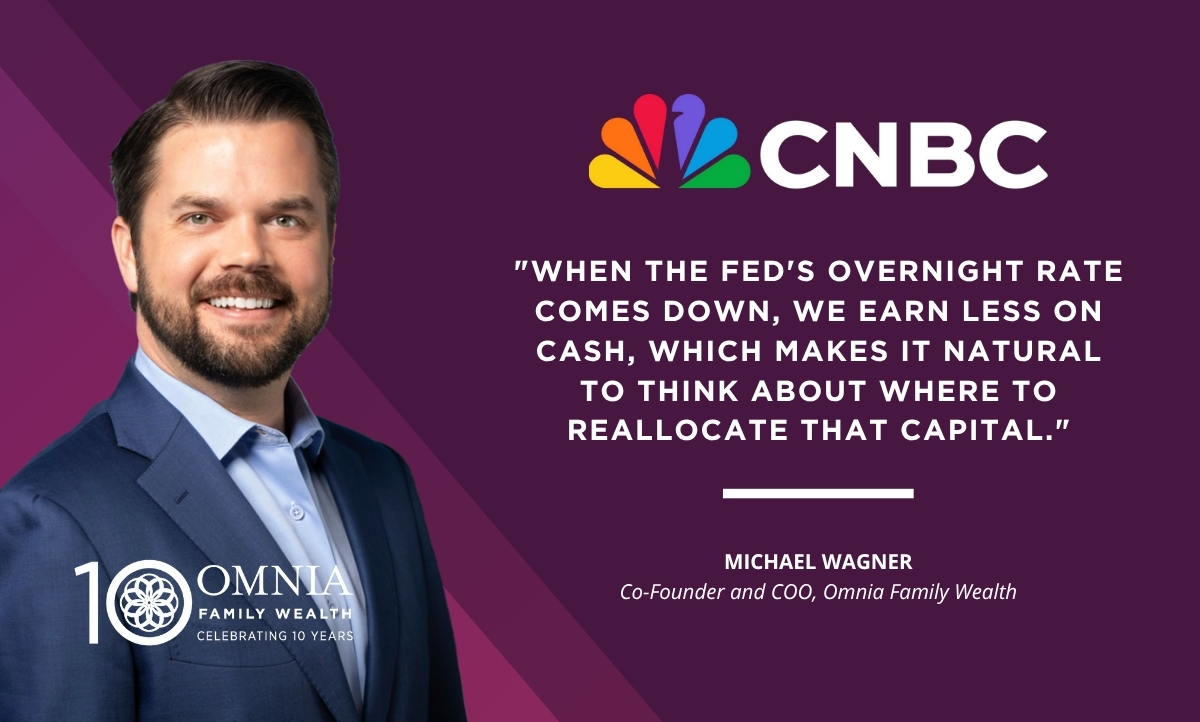
Omnia Family Wealth’s Michael Wagner Featured on CNBC
Read More
PRIVATE CREDIT: OPPORTUNITY AND THE CRITICAL ROLE OF MANAGER SELECTION
Read More